Latest updates
Sign up to The Royal Children's Hospital (RCH) Newsletter for regular updates about what is happening at the RCH diabetes clinic or any diabetes updates.
Sign up to the RCH diabetes newsletter
September 2026
Current type 1 diabetes modification research at RCH
In the last 5 years there has been increasing interest in ‘type 1 diabetes disease modification’. This is an area of research that aims to either prevent or delay the onset of type 1 diabetes (T1D), mainly through the use of various immunotherapies. Immunotherapies are used in many areas of medicine. They are therapies that ’modify’ the body’s immune system to augment or damp down an immune response. In the context of T1D, the therapies are aiming to prevent beta cell destruction and preserve insulin secretion. These research studies usually involve patients within 100 days of diagnosis of T1D or alternatively people who have a high likelihood of developing T1D in the medium term. Our diabetes research group is part of the Australasian Type 1 Diabetes Immunotherapy Collaborative (ATIC).
Details of the various studies that are underway can be seen on the ATIC website https://atic.svi.edu.au/.
From Breakthrough T1D: Change to government Insulin Pump Program (IPP) administration from Breakthrough T1D to Diabetes Australia
For updated information from Diabetes Australia
We are writing to let you know about an important change to the administration of the government’s Insulin Pump Program (IPP).
Following the Department of Health, Disability and Ageing tender process, responsibility for administering the IPP will transfer from Breakthrough T1D to Diabetes Australia, who also administer the NDSS.
For almost two decades, it has been our privilege to administer the program, helping more than 4,000 Australians with type 1 diabetes (T1D) access life-changing insulin pump technology. We are incredibly proud of the role Breakthrough T1D has played in advocating for the program's establishment and expansion, and we thank the many healthcare professionals who have worked with us to support people living with T1D access insulin pumps.
While this marks the end of Breakthrough T1D's role in delivering the program, we support the transition. We believe people with T1D should be able to access all diabetes technology and supplies, including insulin pumps alongside continuous glucose monitors, through a single, nationally coordinated pathway delivered by Diabetes Australia, which also administers the NDSS.
Our advocacy will now continue to focus on our ultimate goal: ensuring every Australian with T1D has equitable access to subsidised insulin pumps, through a graduated approach.
What does this mean for current applications?
Breakthrough T1D is working closely with Diabetes Australia to support a smooth transition and minimise disruption for you and applicants.
A handover process is already underway, with a shared focus on ensuring people who have already submitted and progressed applications are prioritised and that applications continue to be progressed as smoothly as possible.
We appreciate that some applicants and families may be waiting to hear about the status of their application and that you may also be planning for future pump starts. We understand this period of change may create uncertainty, and we thank you and your patients for your patience while the transition is completed. We will continue to work closely with Diabetes Australia to support an orderly handover and will provide further updates as more information becomes available.
What should you do?
At this stage:
- Existing applicants do not need to submit a new application as their application details will be securely transferred to Diabetes Australia.
- We will be emailing applicants today to provide an update and inform them of the next steps regarding their application.
- We are only contacting those with applications currently in progress (including all new applications), as well as previous pump recipients who may be eligible to reapply for an insulin pump (within the past four years).
- We would appreciate your support in providing assurance to applicants that we are working with Diabetes Australia to ensure that the Program will continue with as minimal disruption as possible. We both aim to ensure a smooth and speedy transition of their application.
- Applications will be securely transferred to Diabetes Australia. We will aim to provide most recent updates from you regarding the status of individual applications, however hope that you will understand that there may be some extra follow up from Diabetes Australia during the transition process.
- Diabetes Australia is committed to prioritising those applications that have already provided their paperwork and are just awaiting clinical approval. They will be in contact with you regarding the next steps for these applications.
- If you or your patients have questions about the status of their application and future applications, please direct these enquiries to Diabetes Australia as responsibility for the program transitions to them. They can be reached on ipp@diabetesaustralia.com.au
- We will continue to share updates as they become available, either directly from Breakthrough T1D or from Diabetes Australia.
Thank you for your continued support of people living with T1D and for your partnership with Breakthrough T1D over the past two decades. We remain committed to improving access to diabetes technology through our advocacy and look forward to continuing to work alongside the clinical community to achieve equitable access to insulin pumps for all Australians with T1D.
You can learn more about our advocacy for insulin pump access on our website: https://breakthrought1d.org.au/get-involved/advocacy/advocating-for-access-to-insulin-pumps/
It has been both a pleasure and privilege to work with you over the years to ensure that families, children and young adults have had access to this life changing technology.
August 2026
Omnipod Discover
Omnipod have now transitioned from Glooko to a new platform for reviewing uploads called Omnipod Discover.
See these instructions on how to enrol in Omnipod Discover.
Existing Omnipod users
New users of Omnipod
To link the RCH clinic to your child's reports the clinic code is 50345790.
Libre 3 Sensor availability
Abbott have announced the new Libre 3 will be accessible as a standalone sensor (for use with injected insulin) in Australia from October 1st 2026. Key features are: 15-day wear, readings every minute, all in one application device. The Libre 3 is currently only compatible with the Ypso insulin pump. You can find more information on the Libre 3 sensor here.
If you would like to start using the Libre 3 sensor when it becomes available you will need to email diabetes@rch.org.au to request that your NDSS record is updated to allow access to the Libre 3. As the sensor will only be available from the 1st of October we will not start updating any NDSS records until Monday 28th of September 2026. Please ensure that when you request the update to your NDSS record that you have enough current sensors to cover you until you can collect your new Libre 3 supply.
July 2026
Statement on the Safety of Diabetes Technology
We are aware that recent media coverage has raised concerns about the safety of insulin pumps and other diabetes technologies. We understand that these reports may be worrying for people living with diabetes and their families. While no medical device is entirely without risk, insulin pumps and continuous glucose monitors (CGM) are supported by extensive clinical evidence and have transformed diabetes care for many people. These technologies help improve glucose management, reduce the risk of severe hypoglycaemia and diabetic ketoacidosis, lessen the daily burden of diabetes, and improve quality of life.
We remain confident in recommending diabetes technologies because, for the vast majority of our patients, their proven benefits far outweigh the small risk of device malfunction. Every family cared for by our Diabetes Service is provided with education on safe device use, recognising when a device may not be working as expected, and an individualised back-up plan should this occur. We are here to support you and are committed to helping every child and family use diabetes technology safely and confidently.
See this link from Diabetes Australia
Teplizumab (Tzield) approved by Therapeutic Good Administration (TGA)
You may have heard that Teplizumab also known as Tzield, has been approved by the Therapeutic Good Administration (TGA) for use in Australia. Teplizumab has been found to delay the onset of stage 3 Diabetes (diagnosis of Type 1 Diabetes) and is therefore only approved for use in patients with stage 2 diabetes i.e. before insulin is required.
Teplizumab is a very expensive drug and unfortunately, it has not yet been approved by the Pharmaceutical Benefits Scheme so is not available for general use in the public health system in Australia. Due to the cost involved in accessing this drug it is currently only available through a limited number of research projects. For a list of current research projects underway in Australia please see here for details https://atic.svi.edu.au/clinical-trials/ .
If you have a child who has been diagnosed with Type 1 Diabetes you may want to consider getting any siblings screening for stage 1 or 2 diabetes through Type 1 Screen - https://type1screen.org/. This is a free government run program which would identify Stage 1 or Stage 2 diabetes early, which would allow access to clinical trials and newer agents like Teplizumab when they are clinically available.
For more information about Teplizumab: https://breakthrought1d.org.au/news/tzield-approved-in-australia/
February 2026
Special events
With the observance of Ramadan currently underway, we have some information about how to look after your diabetes during this time.
Ramadan
Discontinuation of MiniMed Mio™ Infusion sets
Medtronic is discontinuing the MiniMed Mio™ Infusion Sets from 1 September 2024, with the introduction of Medtronic Extended™ infusion sets and Extended™ Reservoirs
.png "Mio")
You can transition to the Medtronic Extended™ infusion set (info below), which offers longer wear time and reduces insulin waste. Other Medtronic sets remain available MiniMed™ Quickset, MiniMed™ Silhouette, and MiniMed Sure-T™.
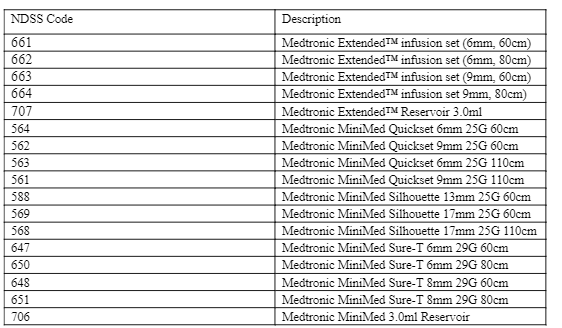
Medtronic Extended™ infusion sets and Extended™ Reservoirs found here:
Changing the Medtronic Extended™ Infusion set
Changing the Medtronic Extended™ Reservoir only
- Allow 24-48 hours for their stock to be delivered to the pharmacy
- If your total daily dose is less than 42 units a day, pair Extended™ Infusion sets with Extended™ Reservoir. If your total daily dose is over 42 units per day, pair the Extended Infusion set with Medtronic standard reservoir NDSS 706 ensuring you have enough reservoirs for the month and enabling reservoir change without changing Extended infusion set.
- Turn Off Set Change Reminder ensuring that a full set change is completed every 7 days
January 2024
Promising research regarding type 1 diabetes
There have been several announcements in the mainstream media over recent months about research regarding type 1 diabetes. Whilst any positive news is exciting, it is important to note that there are many steps that need to occur between an initial idea proving positive at the concept stage to actual changes occurring in the way patients are managed. The process, from initial research, through to animal and then several stages of human clinical trials can take around 10-20 years to complete.
The length of time and mandatory steps required for clinical research is necessary as a concept that works at the cellular level in a petri dish may not actually transfer to safe clinical care for patients. Therefore, when reading any reports of positive research news, it is important to note at which stage of the research project they are at as this will give you some idea of how long it might be until the research results in changes to patient care.
If you have any questions about diabetes research, or studies being undertaken at RCH please ask your Endocrinologists at your next clinic appointment
Are you
still using an Abbott Neo meter?
If you are
using FreeStyle Libre 2 CGM and still using an Abbott Neo Meter, you can
request a free Libre Reader. It is a touch screen, rechargeable glucose &
ketone meter using the same strips as the Neo Meter
To
upgrade to the Libre Reader, visit https://www.freestylelibre.com.au/startmysensor
December 2023
Research update: Baricitinib drug shows promise for suppressing type 1 diabetes progression in people with newly diagnosed type 1 diabetes
You may have seen details in the news recently about some promising results from a study called the BANDIT trial. This world-first Australian clinical trial has shown that a commonly prescribed rheumatoid arthritis drug, baricitinib, can preserve the body’s own insulin production and possibly suppress the progression of type 1 diabetes (T1D) in those newly diagnosed with the condition.
Whilst these results are exciting it is important to note that these are preliminary results from the first year of this trial. As there is further work to be done in this study it is not yet appropriate to change our clinical care until the trial is fully completed and all results appropriately analysed. We will let you know when this happens but is likely to be sometime in late 2024.
If you have further questions about this study, or other studies being undertaken at RCH please ask your Endocrinologists at your next clinic appointment.
October 2023
Online training for family and friends:
Do you sometimes wish your family members and friends knew a little more about diabetes so they could feel confident providing care and support? Diabetes Australia have developed an online learning module aimed specifically at family, friends, babysitters, and nannies who might be responsible for looking after a child with type 1 diabetes. This online module takes an hour to complete and covers topics such as:
- Understanding diabetes
- Monitoring glucose levels
- Insulin delivery devices
- Diabetes Highs
- Diabetes Lows
- Eating to manage diabetes
- Being active
- Being supportive
You can access this online module here Education & events - Diabetes programs - Diabetes Australia and look for the training titled ‘Looking after a child with diabetes’.
MiniMed travel loan insulin pump program:
The Medtronic Travel Loan Program provides you with a spare pump to carry with you while you are away on holiday
overseas or in remote locations where you are unable to receive a replacement pump should your pump fail.
Contact: australia.diabetes@medtronic.com. Medtronic cannot guarantee the availability of a specific model
of the loan pump provided.
Medtronic ask to submit your application two weeks prior to the travel date but with the
holidays approaching earlier than this to avoid delays.
Fiasp insulin to remain on the Pharmaceutical Benefits Scheme (PBS)
On 18 September, Minister for Health and Aged Care, Hon Mark Butler MP, announced that Fiasp insulin will continue to be available on the Pharmaceutical Benefits Scheme (PBS) from 1 October 2023 for people living with diabetes.
More information can be found here; Fiasp penfill lisiting on the PBS
JDRF new book release
JDRF have released a new guide on wellbeing for parents and carers, titled "If you're Okay, They're Okay".
This is a free download providing advice on:
- Support to help parents raise their children with confidence
- Age-appropriate expectations for children living with T1D
- Tips for dealing with the family’s emotional challenges
- Practical advice on common issues
JDRF Parent Wellbeing Guide
September 2023
Essential medical equipment on off annual payment
Did you know that Services Australia (Centrelink) offer an annual payment of $189 dollars to eligible individuals to assist with the electricity cost associated with essential medical equipment. If you are using an insulin pump this may include you. More information about this payment and who is eligible can be found here: Essential Medical Equipment Payment - Services Australia or speak to your local Centrelink office staff.
Please note approval for this payment can be provided by your GP.
RCH Diabetes Newsletters
September 2024
RCH Diabetes Newsletter 10
Topics include:
- RCH Diabetes Website
- My RCH Portal
- Insulin pump funding update
- Site rotation
- Halloween
April 2024
RCH Diabetes Newsletter 9
Topics include:
- BANDIT trial update
- My RCH Portal
- Travelling
- Making the most of your Continuous Glucose Monitor
- Preparing to transition into adult diabetes care
- Supportive resources for children and teenagers with a new diagnosis of type 1 diabetes
December 2023
RCH Diabetes Newsletter 8
Topics include:
- JDRF video link - flying with type 1 diabetes
- Getting ready for the new school year
- Revised clinic glucose targets
- Diabetes distress
- Options for funding an insulin pump
Earlier newsletters
COVID-19 and diabetes
Check into this page for information related to diabetes and COVID-19.
COVID-19 updates
Older updates
Read through all previous diabetes updates in the yearly pages below.
2023 updates
2022 updates
2021 updates
2020 updates
2017 updates